By Anthony Tadros, Senior Training & Workforce Development Professional
How do you expand learning opportunities when training budgets become more limited?
In a rapidly evolving IT environment, continuous learning is essential to workforce readiness and professional advancement. Employees must keep pace with emerging technologies, strengthen existing capabilities, and develop new skills to meet changing mission requirements.
However, professional development is not always about how much an organization can invest in new training resources. Sometimes, it’s about making better use of the opportunities already available.
I saw this firsthand as part of an agency workforce development initiative in which I helped develop a centralized, accessible training system that connected employees with existing learning resources and expanded opportunities for professional growth without requiring additional investment in paid training programs.
Context: Supporting Workforce Development with Limited Resources
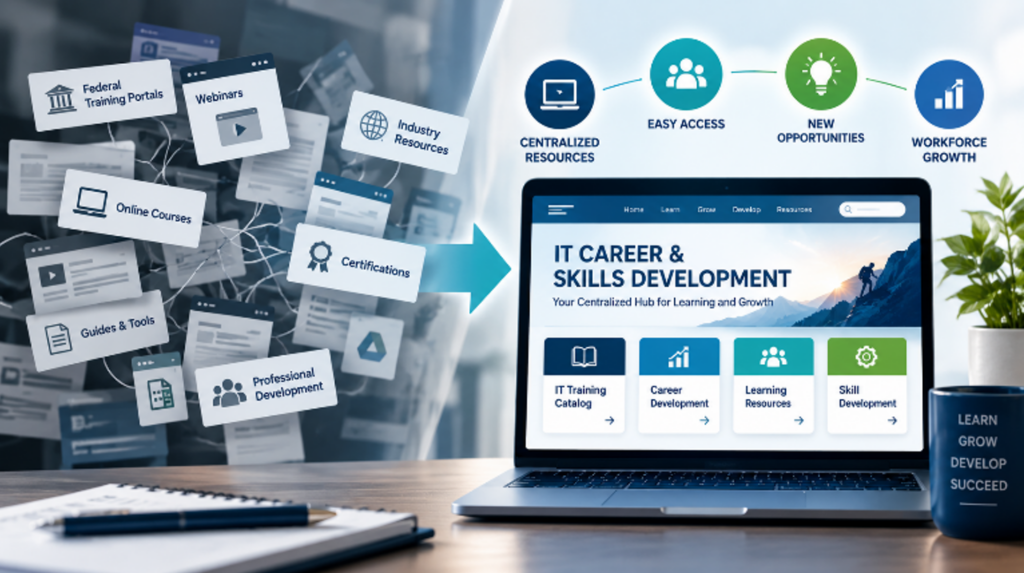
As training budgets decreased, maintaining access to meaningful professional development and upskilling opportunities became increasingly important. At the same time, valuable no-cost learning resources already existed across government agencies, industry organizations, and online learning platforms. The challenge was not necessarily a lack of available training, but rather the fragmentation of these resources across multiple agencies, websites, and platforms, making them difficult for employees to locate and navigate.
My goal was to make existing learning opportunities easier to discover, access, and use while supporting the organization's broader workforce development needs.
Challenge: Connecting Employees to Available Learning Opportunities
Previously, employees seeking professional development often had to navigate multiple websites and search through layers of information to identify relevant courses, certifications, webinars, and career development tools. Even when valuable resources were available at no additional cost, the time and effort required to find them became a barrier to participation.
I wanted to simplify that experience by creating a more accessible and organized approach to continuous learning.
Action: Creating a Corporate Learning Ecosystem
First, I helped develop the IT Career & Skills Development site, a centralized training hub designed to provide employees with a single destination for continuous learning and professional growth. Through this initiative, my team and I brought together previously dispersed resources from within the agency, across government and industry, and through existing learning platforms into a more accessible and organized environment.
A major component of this effort was the development of the IT Training Catalog, an interactive resource featuring hundreds of free courses, webinars, certifications, and professional development opportunities. The catalog covered not only technical skills but also leadership development competencies, recognizing that workforce readiness requires a combination of technical expertise and broader professional capabilities.
Rather than creating another collection of links, I focused on making resources easier to navigate and helping employees identify opportunities aligned with their interests, responsibilities, and career development goals.
My objective was simple: remove unnecessary barriers to learning and give employees greater ownership of their professional growth.
Result: Expanding Access to Professional Development
The result was a centralized learning platform where employees could easily explore training resources, discover career development opportunities, and take a more active role in strengthening their professional knowledge, skills, and abilities by leveraging a comprehensive collection of reputable, freely available training resources.
For the organization, the initiative provided a scalable, cost-effective approach to workforce development by making better use of existing resources. More importantly, it demonstrated that expanding access to professional development does not always require new training programs or additional funding. Sometimes, meaningful improvements come from rethinking how existing resources are organized, connected, and delivered to the workforce.
The Mission Minute: Accessibility Creates Opportunity
One key lesson I took away from this initiative is that workforce development is not defined solely by the size of a training budget, but also by how effectively an organization connects its employees with the tools and resources they need to strengthen their skills, expand their knowledge, and advance their careers.
Technology, resource accessibility, and professional development should work together to create an environment where continuous learning is easier to access and pursue. By reducing barriers to learning and making better use of existing resources, organizations can strengthen workforce capabilities while remaining responsive to evolving mission needs.
What about your organization? As you navigate evolving workforce demands, how are you making professional development more accessible, sustainable, and aligned with mission priorities?
Share your thoughts in the comments below.